
More new lawns in Tampa fail from watering mistakes than from anything else. Too little in the first two weeks and the sod shrinks, the seams open and the edges crisp. Too much for too long and the roots stay shallow, fungus moves in and the lawn never toughens up. On top of that, homeowners are trying to follow watering-day rules that seem built to make new sod impossible. They are not — there is a specific allowance for new lawns. You just need to know how it works and confirm the details with your own utility.
Who sets the rules in Hillsborough County
SWFWMD sets year-round landscape irrigation rules for its whole region, which covers Hillsborough County. Local governments then adopt and enforce their own versions, and they can be stricter. In practice, which rules apply to you depends on who sends your water bill:
- City of Tampa Water Department — most addresses inside Tampa city limits, including South Tampa, Seminole Heights and Hyde Park.
- Hillsborough County Public Utilities — much of unincorporated Hillsborough, such as Brandon, Riverview, Westchase and Carrollwood.
- City of Temple Terrace — customers in Temple Terrace.
Each one assigns watering days, usually based on your address, and the days are not necessarily the same between them. Private wells, reclaimed water and some community systems can have different rules again. If you are not sure which applies, your water bill will tell you who your provider is.
How the year-round rules generally work
For established lawns, the normal pattern in our area has been a limited number of assigned watering days per week, with irrigation allowed only during set hours — generally before 8 a.m. or after 6 p.m., so less water is lost to evaporation in the heat of the day. When the region is in a water shortage, the district or your utility can issue an order that cuts the number of days, shortens the hours or both. Those orders have happened before during dry springs, so do not assume last year’s schedule still applies.
The new-lawn establishment period
Because fresh sod has no roots yet, the rules have generally included a temporary allowance for new lawns and landscaping. The typical pattern looks like this:
| Period after install | What has typically been allowed | Notes |
|---|---|---|
| Days 1–30 | Watering on any day of the week | Still within the allowed hours |
| Days 31–60 | A limited establishment schedule (fewer days than the first month) | Exact days vary by utility — confirm yours |
| Day 61 onward | Your normal assigned watering days | Same as any established lawn |
| During a water shortage order | Allowances may be reduced or changed | Check current orders before installing |
The clock generally starts on the day the sod is installed. That is why we tell every customer to keep the installation invoice with the date on it. If anyone asks why your sprinklers are running on a non-assigned day, that dated invoice is your proof that the lawn is in its establishment period. The allowance is for new plant material — it does not cover the rest of an established yard on the same zone, so if you can, set new-sod zones separately on your controller.
Hand-watering and micro-irrigation
Rules have generally been more flexible for hand-watering with a hose fitted with an automatic shut-off nozzle, and for drip or micro-irrigation in planting beds. That flexibility is useful for new sod: hand-watering a sun-baked strip along the driveway or a corner your sprinkler misses can save a section that would otherwise brown out. How much hand-watering of lawn areas is allowed, and when, varies — check with your utility.
A practical watering schedule for new sod in Tampa
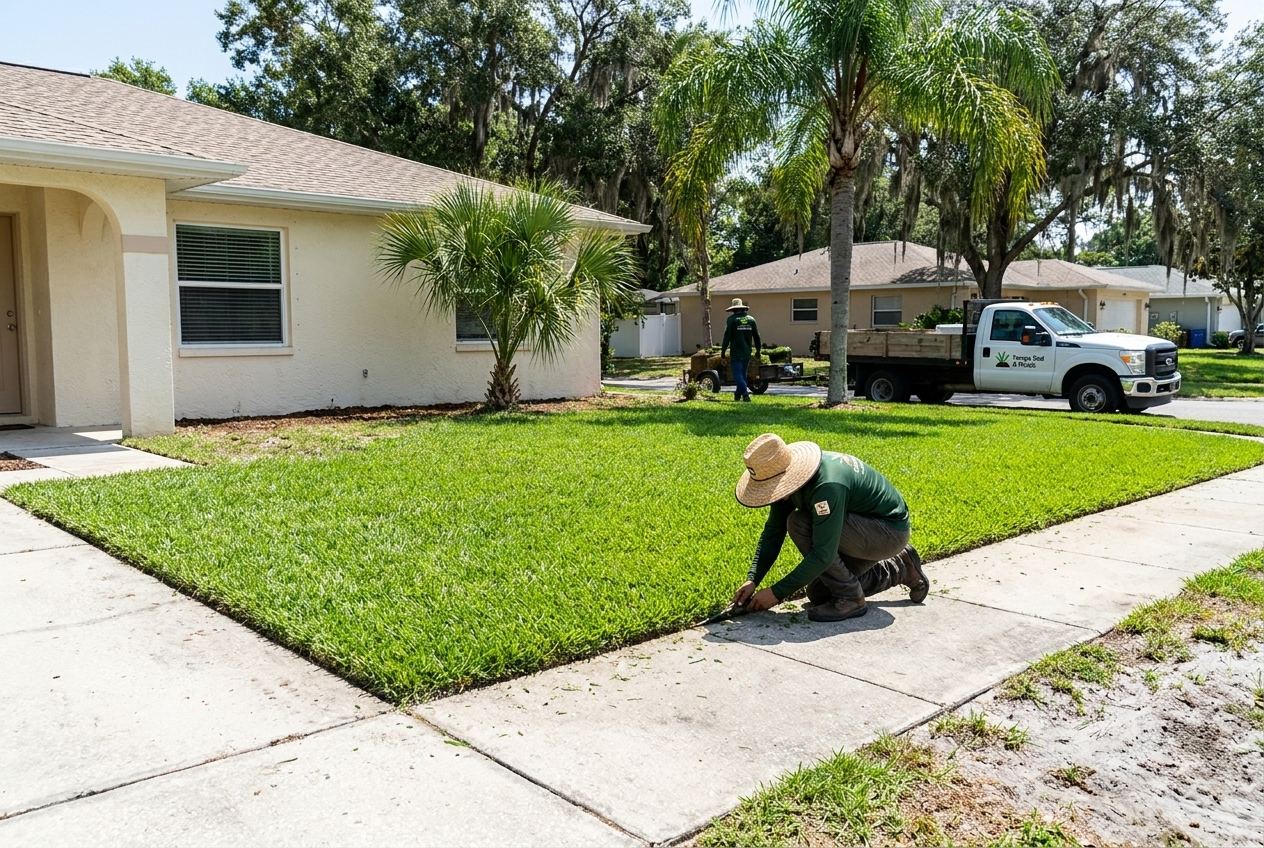
Tampa sand drains fast, which is good for roots and bad for a thin slab of sod sitting on top of it. The goal in the first two weeks is to keep the sod and the top inch or so of sand underneath it consistently moist. After that, you gradually water less often but more deeply, which pushes roots down to find water. Within your allowed hours, a schedule like this works for most St. Augustine and Zoysia installs:
| Stage | How often | What you are aiming for |
|---|---|---|
| Install day | Soak within 30 minutes of laying each section | Water through the sod into the sand beneath |
| Days 1–7 | Twice a day: one early-morning cycle and one evening cycle | Sod never dries out; edges stay soft |
| Days 8–14 | Once a day, a bit longer, early morning | Roots starting to grip — corners resist a light tug |
| Days 15–30 | Every other day, deeper | Roots moving down; sod cannot be lifted |
| Days 31–60 | Follow your utility’s establishment schedule, deep soakings | Lawn holding up between waterings |
| Day 61 onward | Your normal assigned days, roughly 1/2 to 3/4 inch per watering | Water only when the lawn shows mild stress |
Run times depend completely on your sprinkler heads. Rotors put out far less water per hour than spray heads, so a 15-minute run on one zone and a 15-minute run on another are not the same thing. The easiest way to calibrate is to set a few straight-sided cans or cups across a zone, run it, and measure. Your sod installer should leave you a written watering plan that matches your actual system — ours does.
Signs you are getting it right (or wrong)
- Too dry: seams open up, edges turn tan and curl, footprints stay pressed in, a corner lifts easily after the first week.
- Too wet: sod feels squishy, water stands in low spots, mushrooms appear, or yellowing patches show up in the wettest areas — a sign of root rot or fungus starting.
- Just right: by about two weeks, gently pulling a corner meets resistance, and by three to four weeks the sod is anchored.
Adjusting for the rainy season and the dry season
From roughly June through September, afternoon thunderstorms can drop an inch or more in an hour. New sod still needs regular water in the first week, but after a real soaking rain you should skip the next scheduled cycle. Florida requires automatic sprinkler systems to have a working rain sensor or shut-off device; make sure yours actually works, because a system that runs right after a storm is wasting water and drowning new roots. Low, flat parts of the yard that pond in summer are also where fungus starts on new sod, so ease off those zones.
The dry season is the opposite. April and May bring heat, wind, low humidity and little rain, and that is when new sod is hardest to establish and when water-shortage orders are most likely. If you are installing in spring, check for current restrictions first, plan on hand-watering the hot edges, and consider whether waiting until the rains arrive makes more sense.
Get the install right so the watering works
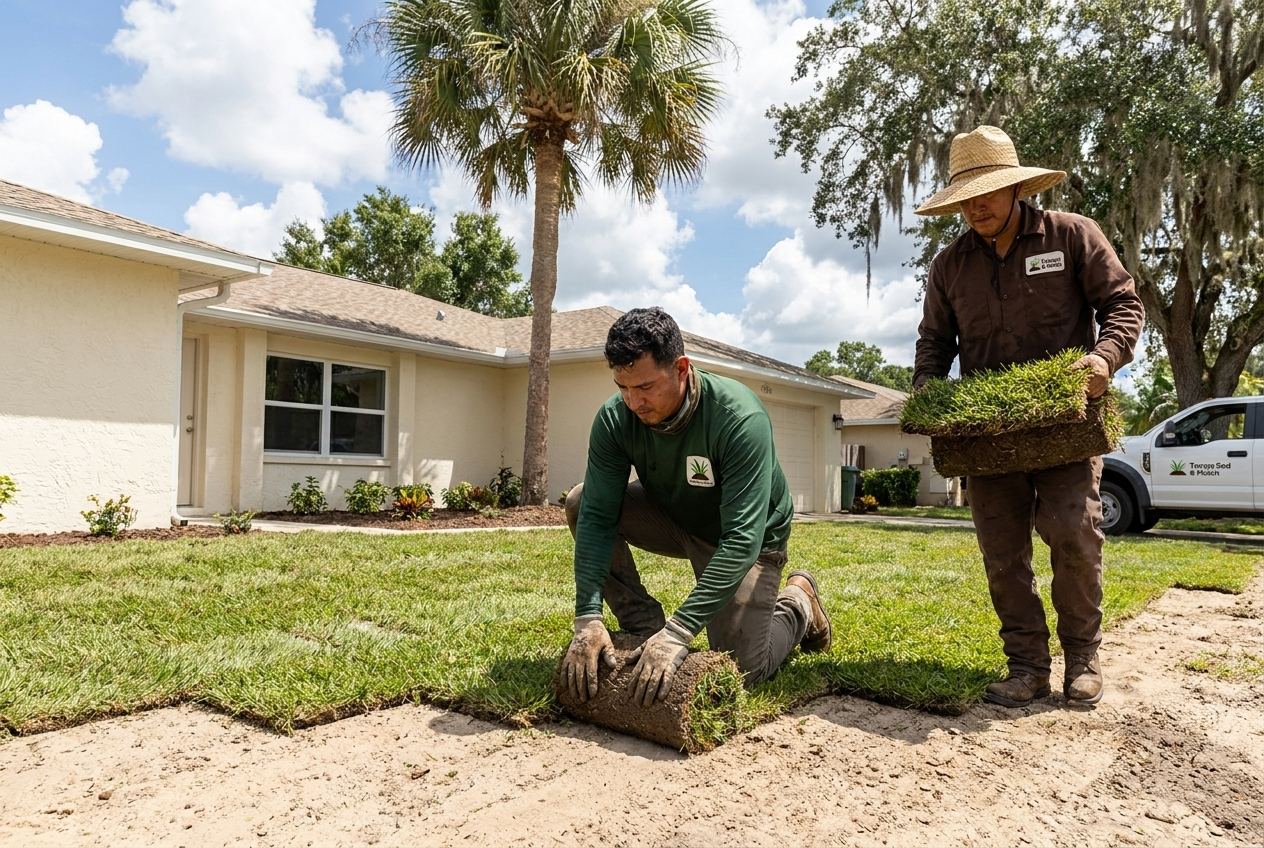
No schedule rescues sod laid on loose, unleveled sand or over buried sprinkler heads. Before installation, heads should be raised to clear the new turf and coverage checked so every part of the lawn gets water. Our bed prep & leveling work includes that check, and every sod installation and lawn replacement comes with a written watering plan and a dated invoice. For the rest of the prep checklist, read how to prep your Tampa yard for new sod, and for help choosing a grass, see the best sod for Tampa lawns.