
Both pine straw and wood mulch do the basic jobs a Tampa bed needs: hold moisture in fast-draining sand, smother weed seedlings and keep roots cooler through the summer. Neither one is universally better. The right pick depends on the bed — how big it is, whether it slopes, how close it sits to the house, how much shade it gets and what your HOA’s landscape rules say.
Pine straw vs. mulch: the side-by-side
| Factor | Pine straw (long-leaf) | Bark / cypress / eucalyptus mulch |
|---|---|---|
| Installed cost per 1,000 sq ft | About $130 – $240 (20–25 bales at $6.50 – $9.50) | About $470 – $750 at 2 in.; $680 – $1,200 at 3 in. ($75 – $120 / cubic yard) |
| Color life | Bright reddish-brown fades to grey-tan within a few months in full sun | Holds color longer; dyed mulch longest |
| Washout on slopes | Excellent — needles interlock and stay put | Nuggets wash and float; shredded holds better |
| Wind | Can blow loose until it settles; holds once knitted | Shredded holds well; small nuggets can scatter |
| Weed control | Good when laid thick; lighter layer lets some weeds through | Very good at 2–3 in. |
| Effect on soil | Breaks down fairly quickly, adds organic matter | Breaks down more slowly, adds organic matter over time |
| Termites | Holds moisture — keep it off the slab | Holds moisture — keep it off the slab |
| Fire / near the house | Dry straw is quite flammable; use care near walls and entries | Can smolder when very dry; generally less flash-prone than straw |
| HOA acceptance | Common in natural areas; some HOAs restrict it in front beds | Widely accepted; color often specified |
| Refresh frequency | About twice a year for a fresh look | About once a year, sometimes twice in full sun |
Costs are based on our installed pricing for long-leaf pine straw, which covers about 40 to 50 square feet per bale, and for pine bark, cypress or eucalyptus mulch, where one cubic yard covers about 100 to 110 square feet at 3 inches or about 160 square feet at 2 inches.
Cost over a full year
Pine straw wins the first-install comparison by a wide margin. Over a year, the gap narrows because straw needs refreshing more often. Two applications of straw on 1,000 square feet run roughly $260 to $480 a year, while a once-a-year 2-inch mulch top-off on the same beds runs about $470 to $750. Straw is still usually the cheaper way to cover big areas — which is why it is so common on large lots in Lutz and Valrico — but it is not as lopsided as the first quote suggests.
Where pine straw wins
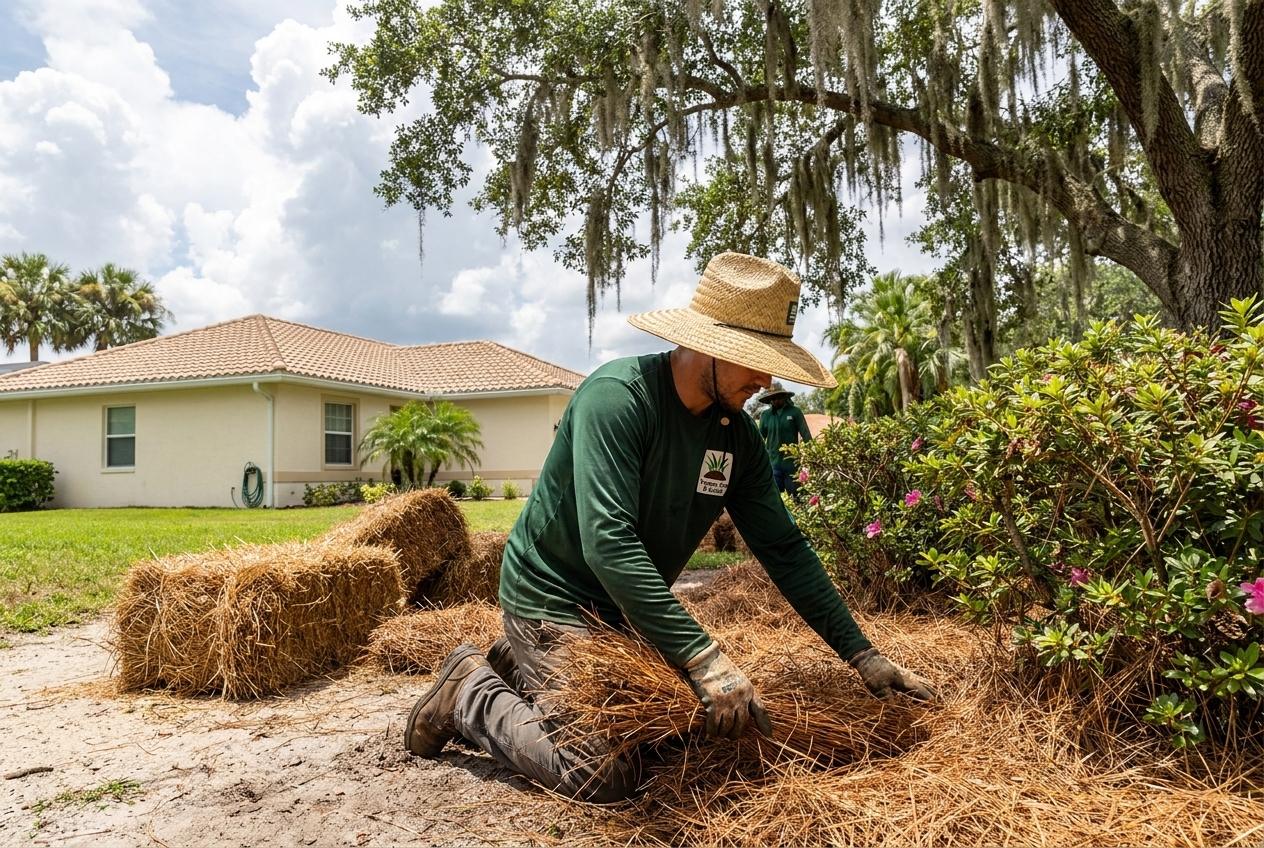
- Slopes, swales and berms. Interlocking needles stay put in Tampa’s summer downpours far better than bark nuggets, which float off at the first heavy storm.
- Under oaks and pines. Under a big live oak, a wide bed of straw looks natural, covers a lot of ground cheaply and replaces the patchy grass that was never going to grow in that shade.
- Large natural areas. Wooded lots, property lines and big island beds, where the cost difference really adds up.
- Acid-loving plants. Azaleas, camellias and gardenias look at home under straw. Straw does not dramatically change soil pH, but it suits the look.
Where mulch wins
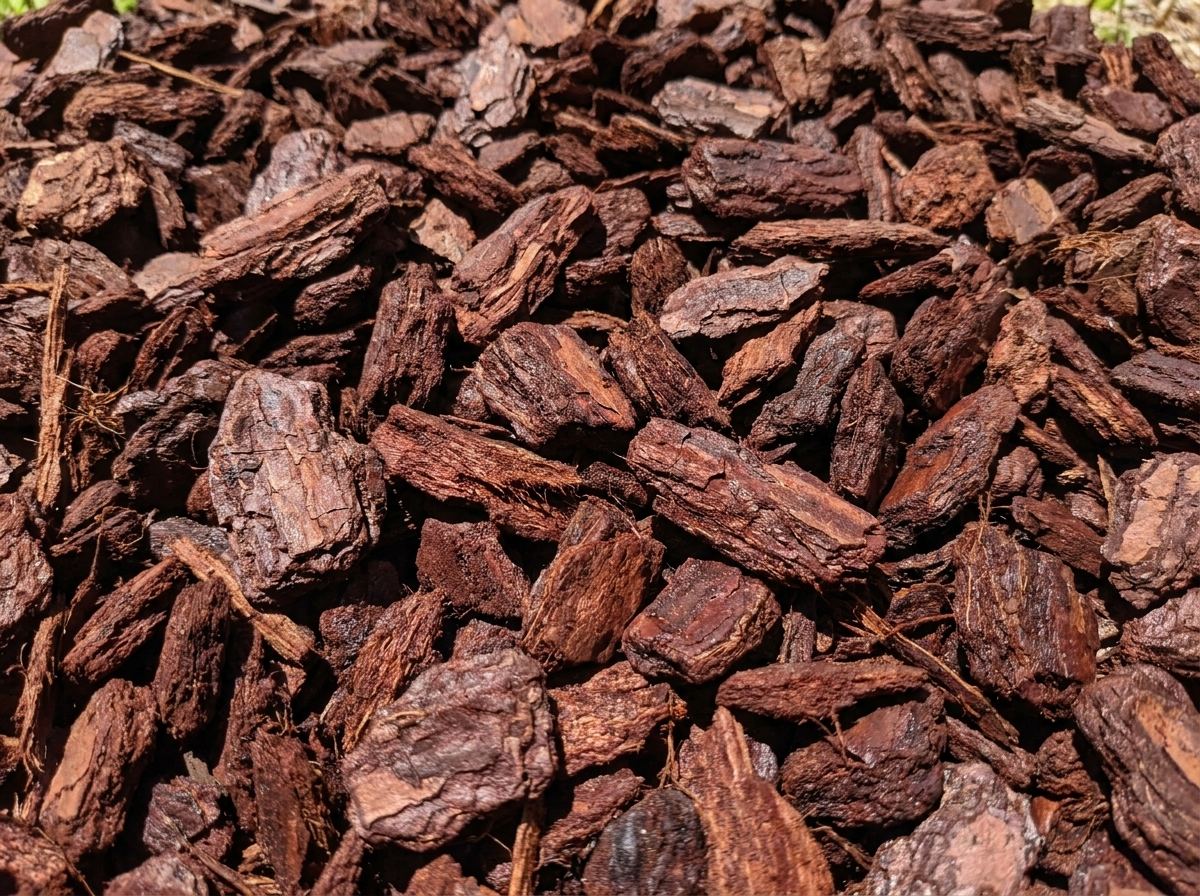
- Foundation beds. Bark or cypress mulch looks crisper against a house, holds color longer and is generally the more conservative choice near walls and entries where dry straw is a fire concern.
- HOA front yards. Many deed-restricted communities in Westchase, New Tampa and Riverview specify mulch type or color for front beds. Check your architectural guidelines before switching.
- Small, high-visibility beds. Entry beds, mailbox beds and beds around pavers, where a tidy, uniform color matters more than cost per square foot.
- Long gaps between refreshes. If you want to touch the beds once a year, mulch is the better fit.
Using both: the combination most Tampa yards should consider
The most practical setup on many Tampa lots is not one or the other. Bark, cypress or eucalyptus mulch goes in the beds along the house and front walk, where it looks clean and keeps flammable straw away from walls. Pine straw covers the big shaded rings under oaks, the side yards, slopes and back corners where it is cheaper and stays put better. A steel or trenched edge between the two keeps them from mixing. In older, oak-heavy neighborhoods like Seminole Heights and South Tampa, this combination often replaces struggling grass under the canopy and looks better year-round.
How Tampa’s climate changes the math
Comparisons written for cooler parts of the country tend to underestimate how hard Tampa is on any organic ground cover. Heat, humidity and year-round microbial activity break both materials down faster here, and the summer sun bleaches color quickly. That hits pine straw hardest: its bright reddish-brown can fade to a grey-tan in a single summer on a west-facing bed. Bark and cypress mulch fade too, but more slowly, and dyed mulches hold their look longest.
Rain changes the picture in the other direction. From June through September, daily storms send sheets of water across flat lots and down any slope. On a berm, along a swale or at the edge of a driveway apron, pine straw is the material that is still there in September. Bark nuggets on the same slope often end up against the curb after the first big storm. Spring is the opposite problem: April and May are dry and windy, and a freshly laid layer of straw that has not knitted together yet can shift in strong gusts, so we tuck the edges tight and lay it thick.
Weeds are the last factor. Tampa’s growing season never really stops, so whichever material you use has to be deep enough to block light all year. A thin layer of either one will grow dollarweed and nutsedge within weeks. Proper depth, a clean bed before installation and a defined edge matter more than which material you choose.
How each one is installed
For either material, the bed should be weeded and edged first. Pine straw is shaken out and tucked tight along edges so it locks together, laid thick enough to block light — typically 3 to 4 inches loose, settling down over a few weeks. Mulch goes down at 2 to 3 inches and is kept off trunks and the slab. If you are deciding on timing as well as material, our post on when to mulch in Tampa covers the calendar.
Get both quoted side by side
We install both and will quote them side by side for your beds. See pine straw installation and mulch installation for details, or mulch delivery if you would rather spread it yourself. Clean edges make either one last longer — our landscape edging keeps straw and mulch in the beds and St. Augustine out.